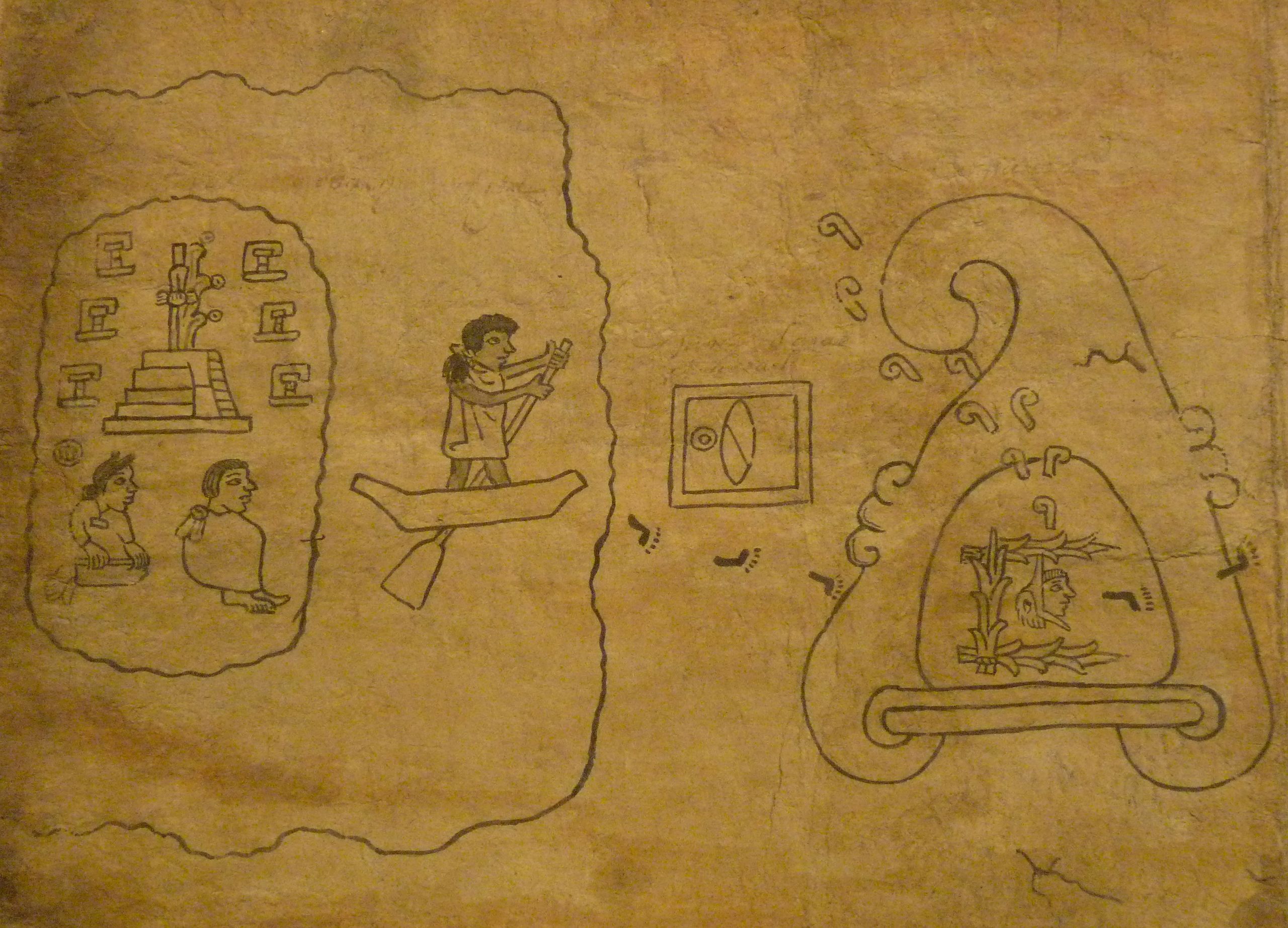
The Codex Boturini documents the founding myth of the Mexica people and their migration from their spiritual homeland in Aztlán to the Valley of Mexico. It is a 5.5-meter-long strip of sacred amate (fig bark) paper painted in the early post-conquest era, likely between 1530 and 1541.
I have researched each panel of the Codex Boturini (also known as the Tira de la Peregrinación de los Mexica) and put my best interpretation of each folio into the spreadsheet below. It’s an easy-to-read understanding of the codex.
(Google Sheets spreadsheet features each Folio of the Boturini Codex with a description.)
Instead of a bound book, the codex is a single continuous sheet folded like an accordion into 22 distinct folios. Using elegant black outlines and minimal color, an indigenous master scribe (tlacuilo) mapped out the foundational myth of the Aztec Empire: their 187-year migration from the mythical island of Aztlán to the Valley of Mexico.
The codex ends abruptly with two Mexica soldiers marching off to war. For some unknown reason the document wasn’t finished. It is currently housed at the National Museum of Anthropology in Mexico City.
People from Codex Boturini
- Huitzilopochtli: The patron war and sun deity of the Mexica, guiding the tribe via an invisible voice, speech scrolls, or a hummingbird messenger. He is identified on multiple slides as a face emerging from a hummingbird’s mouth.
- Chimalma(n) (“Shield Hand”): An esteemed ancestral woman/spirit figure who initiates the migration on Folio 1 and serves as one of the original god-bearers.
- Mixcoatl: The unnamed male companion to Chimalma on the island of Aztlán (identified through cross-references with the Crónica Mexicáyotl).
- The Teomamaque (God-Bearers): The four principal tribal leaders/priests who carry the sacred deity bundle on their backs: Tezcacoatl, Cuauhcoatl, Apanecatl, and Chimalman.
- The Mimixcoa: The first ritual sacrifice victims on Folio 4, named individually as Xiuhneltzin (first), Mimichtzin (second), and their unnamed elder sister.
- Tezozomoc (?): The legendary, powerful tlatoani (ruler) of the Tepanec empire seated in authority on Folio 16.
- Huehue Huitzilihuitl: The elder Mexica leader captured during the disastrous defeat at Chapultepec.
- Chimalaxoch: Daughter of Huehue Huitzilihuitl, captured alongside her father on Folio 18.
- Lord Coxcox (Coxcoxtli): The formidable ruler of Culhuacan who subjugates the Mexica and sends them to war as mercenaries.
Aztlan Journey Places
The Google Map below traces several narratives of the Aztlan journey, including those of Duran, Chimalpahin, Codex Boturini and others. It is a work in progress.
- Aztlán (The Island Origin)
- Colhuacan / Teoculhuacan (The Sacred Curved Mountain)
- Itzintla / Cuahuitl Itzcalloc (The Location of the Broken Tree)
- Chichimeca Lands (The Arid Wilderness / Desert of Cacti)
- Chocayan (Place of Weeping or place where the Huastecs wept)
- Coatlicamac (At the Serpent’s Mouth) – New Fire Ceremony
- Tollan / Tula (Place of Reeds)
- Atlitlalaquian (Where Water is Swallowed)
- Tlemaco (In the Fire Pan)
- Apaxco (Where Water Drains)
- Atotonilco (Place of Hot/Boiling Water)
- Huitzcoltepetl / Huitzcol Hill (Twisted Thorn Hill) – New Fire Ceremony
- Tzompanco / Zumpango (Place of the Skull Rack)
- Xaltocan (Sand Spiders)
- Acalhuacan (Place of Canoes)
- Ehecatepec (Wind God Hill)
- Tulpetlac (The Tule-Reed Mat)
- Cohuatitlan (Place of Serpents)
- Chalco (Place of Green Stones)
- Huixachtitlan (Hill of the Acacia Bush)
- Tecpayocan (Hill of Flint Knives) – New Fire Ceremony, 1246 CE
- Pantitlan (Place of Banners Whirlpool – First Stay)
- Amalinalpan (On the Water of Wild Twisted Grass)
- Tetepanco / Azcapotzalco (The Tepanec Capital Border)
- Pantitlan (Place of Banners – Second Stay / Epidemic)
- Acolnahuac (By the Curved Arm/Shoulder)
- Popotla (Place of Wild Straw/Reeds)
- Techcatitlan (Place of the Sacrificial Stone)
- Atlacuihuayan (Place of the Spear-Thrower / Modern Tacubaya)
- Chapultepec (Grasshopper Hill) – New Fire Ceremony
- Acocolco (Twisted Waters Battleground)
- Culhuacan (The Urban Kingdom of Vassalage)
- Xochimilco (In the Flower Field Battleground)
This video from INAH (in Spanish) is a great resource about the Codex Boturini.
1. Sources: Institutional Digital Repositories & Archives
- The INAH Codex Boturini Digital Project: Used to cross-reference the layout and structural approaches of the National Institute of Anthropology and History (INAH) in Mexico, which safe-keeps the original manuscript (Manuscript 35-38). [1, 2]
- The Wikimedia Commons Codex Boturini Database: Provided individual panel high-resolution photographic files (specifically verifying the composition, multi-tiered narrative lines, and characters of Folios 14, 15, 16, 20, and 21). [1]
- The Internet Archive Library Collection: Leveraged to access digitized physical commentary sheets regarding the structural flow of the Tira de la Peregrinación. [1]
2. Scholarly Research & Historic Literature
- Dr. María Castañeda de la Paz: Academic publications and structural lectures (such as her work out of the Anthropological Research Institute of the UNAM) were utilized to verify the exact identification of the 8 migrant tribes on Folio 2, the identification of Mixcoatl on Folio 1, and the geographical mapping of the Valley of Mexico toponyms. [1, 2, 3]
- Dr. Angela Rajagopalan / University of Texas Press: Consulted through academic review frameworks detailing Portraying the Aztec Past: The Codices Boturini, Azcatitlan, and Aubin to confirm multi-tiered timeline transitions and the historical significance of the weaponless Xochimilco campaign. [1, 2]
- Archaeologist Bertina Olmedo (INAH): Referenced for contemporary theories linking the Tollan/Tula flight narrative to the geopolitical vacuum left after the historic fall of Tula.
If you have corrections or comments please email to mexicapodcast at gmail.com