Formal name: Ahuitzotzin
Life: 14??-1502
Reign: 1486-1502, 1485-1502 (Tira de Tepechpan)
Name: Water possum, water creature
Place of Birth: Likely Tenochtitilan
Upon the death of Tizoc, the lords met and Tlacaelel began to advocate for his young grand nephew Ahuitzotl, a child at the time, according to Duran. Other sources say he was already an accomplished military leader and priest. Around 1486 Ahuitzotl was chosen to be the eighth tlatoani of Tenochtitlan and Huey Tlatoani of the Triple Alliance, overseeing an empire that stretched across the valley of Mexico to the mountains in the west and to the Gulf of Mexico to the east.
Ahuitzotl’s first effort was his inaugural campaign to put down a rebellion in the coastal region in northern Veracruz where the Huastec Nation was testing the new king. Recently subjugated by his brother Tizoc, Ahuitzotl led the army to victory and returned to Tenochtitlan with captives for his coronation festivities.
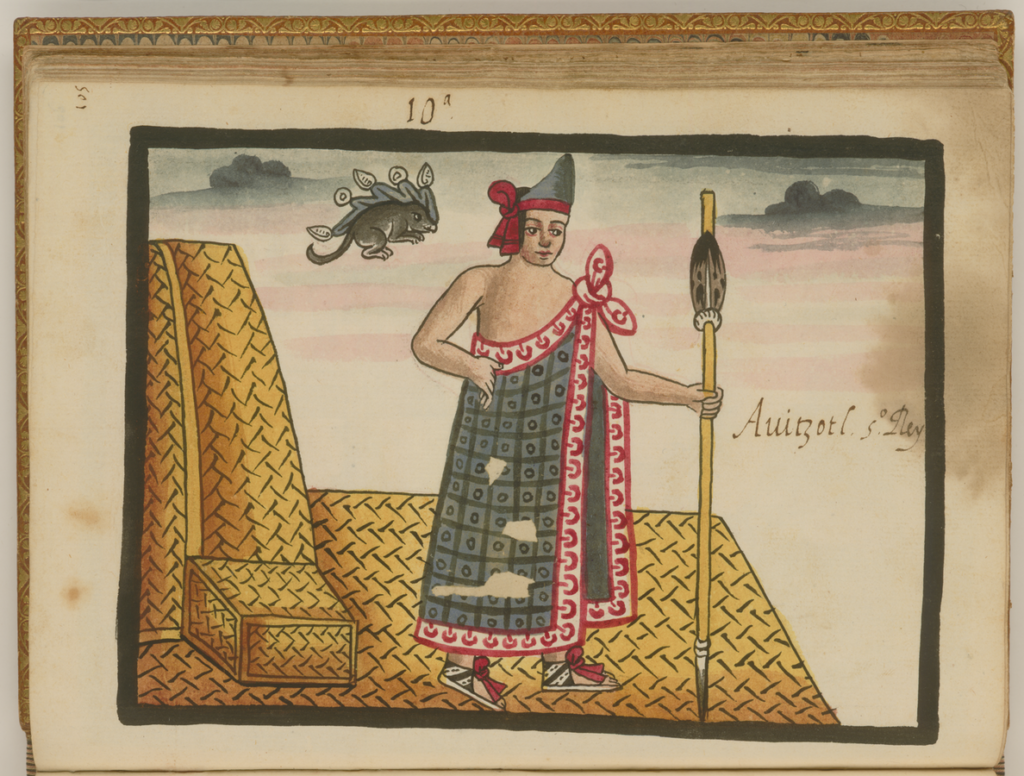
A huge coronation festival was thrown with allies and enemies both invited, lasting several days. The festivities were attended by the leaders of the Triple Alliance and other city-states. Sacrifices were made, feasts were held and dancers danced.
Pacific Coast wars: Oaxaca and Tehuantepec
Known for his proficiency as a commander in battle Ahuitzotl moved south to Tehuantepec on the Pacific Coast and further down almost to the modern border of Guatemala. Ahuitzotl enjoyed easy victories in Oaxaca and Tehuantepec personally leading the mixed forces of the Triple Alliance. Other towns willingly offered their subjugation. The young king returned to Tenochtitlan to a hero’s welcome. Later in his rule he would send the armies to Oaxaca later to quell the people again.
Great Temple
One project linked to Ahuitzotl’s reign is the sixth expansion of the Templo Mayor, completed in December of 1487. According to History of the Indies, when Ahuitzotl declared that he would improve and expand the Great temple, his uncle and chief advisor Tlacalael cried with joy. It’s been hinted that the previous ruler, Tizoc, was murdered in part for his lack of enthusiasm to push the Templo project. Once work resumed under Ahuitzotl laborers came from across the empire to construct the massive earthwork project. Various materials were brought from the cities best suited to produce them.
Once the temple was finished, Ahuitzotl called for a great celebration and all the cities of the empire were invited. The young king invited both allies and enemies alike to participate in the opening ceremonies. Envoys were sent to Tenochtitlan, each bringing gifts and slaves for sacrifice on the new temple. According to one Catholic account there were 80 thousand sacrifices made over four days. This number seems impossibly high. It describes four columns of sacrifices leading up to the top of the temple, and that there was so much blood that the city reeked of death. Additional improvements made by Ahuitzotl included a wall around the Sacred Precinct and the Temple of the Eagle Warriors.
Around this time, Tlacaelel, the legendary advisor of Mexica lords since he spent his youth running alongside Itzcoatl, died in 1487. According to legend he was 120 years old, but probably around 90 when he died. He had created the role of Cihuacoatl, or high advisor, essentially by being himself. His son Tlilpotonqui was appointed as the second Cihuacoatl and would serve Ahuitzotl and Moctezuma the Younger.
The Anales de Mexico lists several natural disasters, but I didn’t catch these mentioned in other texts. It lists an earthquake in 1489, in 1490 heavy hail killed fish and animals. Then in 1491 a grasshopper infestation claimed crops. The Anales lists another earthquake in 1496.
Acuecuexco Aqueduct
As part of his efforts to improve the city Ahuitzotl commissioned a new aqueduct from the Acuecuexco spring in Coyoacan. King Tzutzumatzin of Coyoacan issued a gracious warning about the spring, advising the Tenochca leader of potential flooding danger with the project. Displeased with the negativity and warning, Ahuitzotl had King Tzutzuman killed and he then moved forward with the aqueduct project. The assassination proved to be unpopular across the empire.
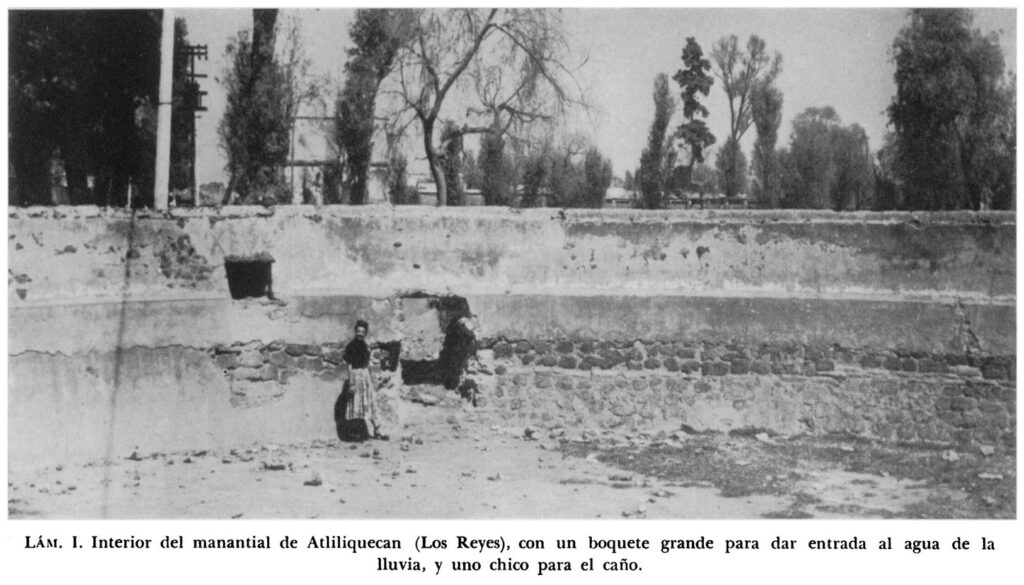
On the day of the aqueduct opening there was great pomp as priests dressed as the rain god Tlaloc and Chalchiuhtlicue, goddess of fresh and flowing water. With great drumming and throwing of idols and gifts, the Acuecuexco spring was opened and water gushed forth as the priests danced and sang. Children were tortured so their tears could be extracted for Tlaloc, then sacrificed. Soon the water began to back up within the dams and channels, then it began to overflow the walls and canals until the chinampas and streets flooded. The flood damage was so bad, according to Duran, that much of the population fled the city.
Ahuitzotl sought the help of Nezahualpilli of Texcoco, who gave him a big ol’ “told you so” for disregarding the warnings of King Tzutzuman. But he offered divers to go and seal the spring. So, according to the Mexican Chronicle, the divers sacrificed children below the surface of the water, priests again came to throw statues and sacrifices into the spring and the water stopped flowing.
The History of the Chichimeca Nation states that Ahuitzotl was in his garden when the flood reached him, in fleeing he hit his head on a doorway causing him a lingering wound that would take his life. The writer claims this injury eventually killed Ahuitzotl, despite attempts to save him, even removing parts of his skull. Other versions simply have him surviving the incident but with deep guilt and shame for his decision to ignore King Tzutzumon’s warnings, and having him assassinated for his good advice.
Duran and Cronica Mexica say that Ahuitzotl survived the flood and went on to improve the city, providing food and material goods to entice people back to Tenochtitlan as well as a return campaign to Oaxaca to quell the locals.
Ahuitzotl became ill, quickly emaciating until he died, according to Duran. The Cronica doesn’t specify how he died, but says he carried deep shame for the Acuecuexco Aqueduct catastrophe. One of his final acts was to commission a statue of Totec, the flayed god of agriculture. He saw it in person and was pleased.
Whether he was killed as a direct result of the flood, or of some unrelated illness, is a mystery. Ahuitzotl was honored with great celebration and ritual. His reign saw the expansion of the Templo Mayor and the Sacred Precinct and expansion of the empire along the Gulf of Mexico and Pacific Coast. Following the funerals, Totoquihuatzin of Tlacopan, and Nezahualpilli of Texcoco selected Moctezuma II to be the next emperor.
Ahuitzotl’s Accomplishments
Completed Tizoc’s Templo Mayor expansion.
Huastec Rebellion victory.
Completed the Acuecuexco Aqueduct from Coyoacan to Tenochtitlan.
Led wars, including against Xolotla, Xoconochco and others.
Tizoc <<- Ahuitzotl ->> Moctezum II