Formal name: Cuauhtemoctzin Life: 1502-February 28, 1525 Reign: 1520-1525 Name: diving eagle Place of Birth: Tenochtitlan or Tlatelolco Death: Itzamkanac, Tabasco, hung by Cortes.
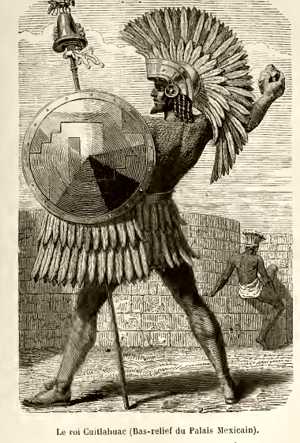
Following Cuitlahuauc’s death, Cuauhtémoc was immediately installed to lead the Mexica, in part, because there were a dwindling few who qualified. Cuauhtémoc did have both noble lineage and characteristics desired in a leader and he lived up to the challenge.
Nothing is known of his youth. Born around 1495 or 1496, he was a son of the 8th tlatoani of tenochtitlan, Ahuitzotl, and cousin to Moctezuma II. His mother was Tiyacapantzin, a princess from Tlatelolco. We can speculate on some standards in an elite upbringing, like perhaps attending the youth academy for nobles and that he was likely born in Tenochtitlan during his father’s reign.
Formal name: Cuitlahuatzin Life: 1476-1520 Reign: 1520-1520 Name: place of excrement Place of Birth: Likely Tenochtitlan Death: Tenochtitlan, of smallpox.
Cuitlahuac took power during the occupation of the Mexica capital city in 1520 when Cortes and his Indigenous allies were holed up in his father’s palace. Before Moctezuma was killed the Mexica forces were rallying behind Cuitlahuac. The conquistador Diaz, who was present in Tenochtitlan during the palace siege, said Cuitlahuac was outside the palace every day rallying fighters and motivating his warriors to keep up the fight. I imagine Diaz peering out of a crack in a barricade and seeing Cuitlahuac fighting for his people. Cuitlahuac was the leader the Mexica needed in that moment, fiery and clear on the threat the Castilians posed.
Biography of Moctezuma, Ninth Tlatoani of Tenochtitlan.
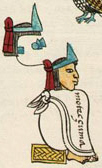
Formal name: Moctezuma Xocoyotzin Life: 1468-1520 Reign: 1502-1520 Name: Angry Lord Place of Birth: Likely Tenochtitlan Death: Palace of Axayacatl, Tenochtitlan, killed by Spaniards or possibly Mexica mob.
The day after Ahuitzotl’s ashes were interred in the Sacred Precinct a council was formed to select the next ruler. There were many choices. After some discussion all the lords there unanimously selected Moctezuma.
Born around 1468, Moctezuma was the son of Tlatoani Axayacatzin, nephew of previous tlatoque Tizoc and Ahuitzotl, and also a noted military leader and religiously devout man. He had served as Tlacochcalacatl, or military general, the highest rank in the Mexica world and it was said his military advice was always sound. He was a natural choice.
During a coronation ceremony likely held in 1502, retold in detail by Duran, the new king vowed to care for the people of Tenochtitlan, including the old, the young, the gods and warriors. How accurate Duran’s writings are is not clear but the scene he sets is one of a powerful oath taken to his people.
One of his first moves was to replace most of the heads of state his uncle Ahuitzotl had appointed across the empire. He contended many were commoners and it was unbecoming of the empire to not have nobles in place. Traditional views about the role of nobility would be a hallmark of his rule, making him a sort of Aztec Conservative with religion and tradition being central to his core beliefs.
Coronation
Moctezuma’s reign from his coronation until the arrival of Cortes was like the previous rulers. He spent time marching the army to various rebellions and wars. His inaugural war was against Nopallan in the southern state of Oaxaca. This land had already been conquered, but it’s people rebelled and Moctezuma marched to put them down, and collect sacrificial victims for his coronation festivities.
Moctezuma returned from the Pacific Coast with sacrifices for his festival. Invites were sent, preparations were made. On the chosen day, guests from across the empire began to arrive. There was dancing, music and sacrifices, of course. The festivities were well received by all guests and soon they left, impressed by the new king’s wealth and status.
During his reign Moctezuma Xocoyotzin went to war against Tlaxcala, Huejotzingo and numerous campaigns back to Oaxaca.
The Catholic sources begin to detail a series of omens; a comet, a strange bird, a two-headed man – all of these supposedly foretold the coming of Cortes. Some of the Catholic sources also indicate that the Indigenous people thought Cortes was Quetzalcoatl, returning to fulfil a prophecy. Today historians and modern storytellers reject these as Catholic narrative building. His arrival was, however, one of the biggest moments in human history.
Arrival of the Spanish
Cortes was the third Spanish captain to show up on the Mexican coast, and the second to speak to the local Aztec leaders, Capt. Grijalva met Aztecs the year before Cortes, in 1518. Moctezuma had received reports of these strangers for at least a year before he met Cortes on that fateful day in the streets of Tenochtitlan. There are many opinions on the handling of the Spanish by Moctezuma. It seems he chose a path of political appeasement which ended up leading Cortes into the heart of his capital. Soon the Spanish seized Moctezuma and moved him to their quarters, the palace of his father, the former ruler Axayacatl. On one fateful night, while Cortes was away from the city, the Spanish committed a brutal attack on the people of Tenochtitlan, who were celebrating the Toxcatl Festival. The core of Mexica nobility and military leadership was eliminated in one savage event.
When Cortes returned, now with 900 fresh troops and 80 horses, Moctezuma tried to put the massacre behind them by hosting a feast for Cortes. This did not go over well with the traumatized populace. Cortes continued to hold him in the palace until his death, most likely caused by the Spanish, but often cited as the victim of a stone cast by his countrymen in protest to his perceived weakness. There was certainly that sentiment at the time among the Mexica, who could not understand the continued entertainment of these violent men by their king. But in losing power over his countrymen Moctezuma would also have lost value to Cortes.
Whether by a stone to the head, or a knife to the ribs or whatever manner he died. The story of what happened to his body also has many varying accounts. One account says Moctezuma’s corpse was wrapped in cloth and left in the corner of the palace, found on the Noche Triste after the Spanish had snuck out. Another tells how Moctezuma’s own nobles carried the body out to the people, which triggered the revolt. Others say the body was unceremoniously dumped in a canal by the Spanish, and found by the Mexica. At least one account says his body was recovered and cremated in the manner of all Mexica rulers. It seems, to me, that Moctezuma died in a state of real and perceived weakness, held captive in his own city – unwilling to encourage violence against the Spanish.
Today, Moctezuma is the most well-known of the Aztecs. Americans joke about “Montezuma’s Revenge” when they invariably get sick on vacations to Mexico, invoking the ghost of an angry lord. Sadly, this context was my own introduction to the Aztecs. I understood it was a joke, but the idea of a displaced king cursing the descendants of his conquerors stayed in my imagination. Moctezuma was a noble man of intelligence and dignity but history fated him for one of its greatest demises. In his life he was an accomplished military captain, devout religious man and a respected member of the nobility and he should be remembered as such.
The empire was in a state of collapse when Moctezuma died, invaders occupying the capital, disease spreading, allies turning on them and an army weakening by the day. On June 30, 1520 the Spanish left the city on what would become known as “The Noche Triste” or to Indigenous folks, “La Noche Victoriosa,” as this was one of the few victories the Mexica and their allies would ever get over the Spanish.
With their capital back in their possession, the Mexica began to recover from the violent occupation and massacre but a new diseases was taking hold – smallpox. And a new leader was needed.
Moctezuma II’s Accomplishments Extended the Empire south, into Zapotec lands. Removed commoners from power, installed nobles. Built a palace that would come to mark the seat of power in Mexico to this day.
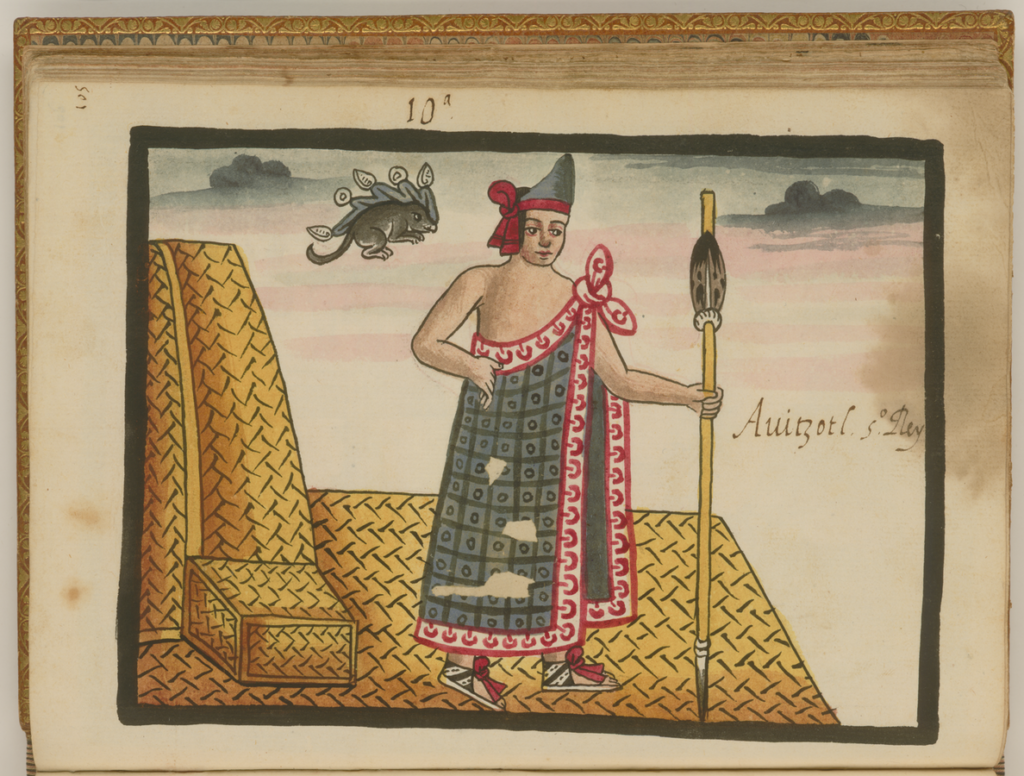
Formal name: Ahuitzotzin Life: 14??-1502 Reign: 1486-1502, 1485-1502 (Tira de Tepechpan) Name: Water possum, water creature Place of Birth: Likely Tenochtitilan
Upon the death of Tizoc, the lords met and Tlacaelel began to advocate for his young grand nephew Ahuitzotl, a child at the time, according to Duran. Other sources say he was already an accomplished military leader and priest. Around 1486 Ahuitzotl was chosen to be the eighth tlatoani of Tenochtitlan and Huey Tlatoani of the Triple Alliance, overseeing an empire that stretched across the valley of Mexico to the mountains in the west and to the Gulf of Mexico to the east.
Ahuitzotl’s first effort was his inaugural campaign to put down a rebellion in the coastal region in northern Veracruz where the Huastec Nation was testing the new king. Recently subjugated by his brother Tizoc, Ahuitzotl led the army to victory and returned to Tenochtitlan with captives for his coronation festivities.
Illustration of Ahuitzotl. Codex Tovar, 1587-1588.
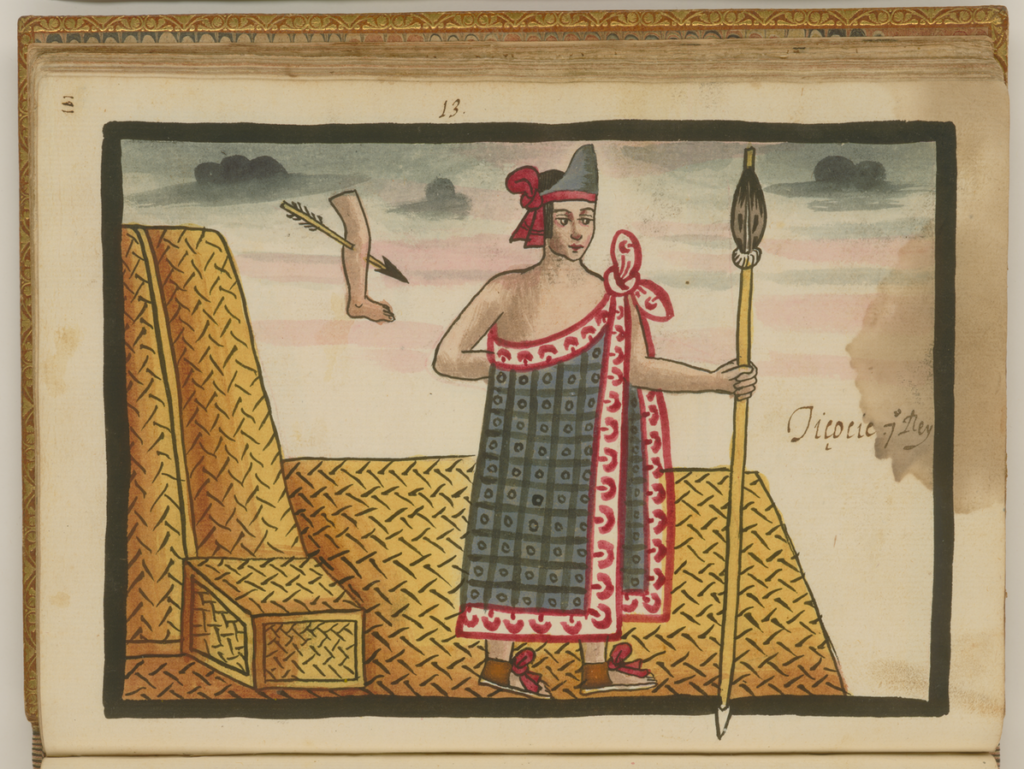
Formal name: Tizocicatzin Life: 1449-1486 Reign: 1481-1486, 1481-1485 (Tira de Tepechpan) Name: He who makes sacrifices, he who does penance Place of Birth: Likely Tenochtitlan
Following the 80 days of funeral ceremonies for Axayacatl, the two remaining leaders of the Triple Alliance, Nezahualpilli of Texcoco and Chimalpopoca of Tlacopan, met with the Mexica high priest and advisor Tlacalael. They selected Tizoc to be the next tlatoani of Tenochtitlan. Tlacalael, in part, chose his grand nephew Tizoc out of loyalty to his dead brother, Moctezuma the Elder.
Tizoc was born around 1449, grandson of former emperors Moctezuma I and Itzcoatl, and the middle brother of three who would follow each other as tlatoani, Axayacatl, Tizoc and Ahuitzotl.