
Formal Name: Moteuczomatzin
Life: 1397/98-1469/1471
Reign: 1440-1469/1471
Name: Angry Like a Lord, fletcher of the sky
Place of Birth: Tenochtitlan
Died: Tenochtitlan, of illness.
Moctezuma Ilhuicamina, or Moctezuma the Elder, and his brother Tlacaelel were at the heart of the Mexica nobility and served as young generals under the violent leadership of Itzcoatl. They were part of a militant political faction that had raised Itzcoatl to the throne and stood in opposition to their other brother, and former tlatoani Chimalpopoca. After Chimalpopoca‘s assassination Itzcoatl, Moctezuma, Tlacaelel and their group took power. Moctezuma and Tlacaelel had big ambitions for the growing Mexica people.
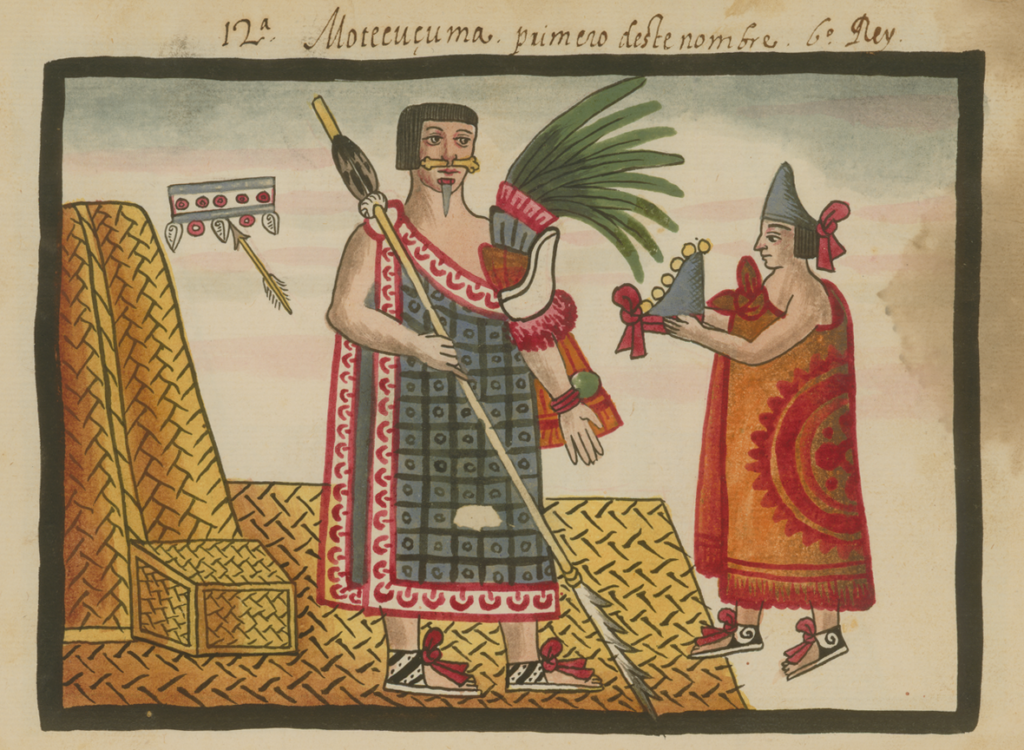
During his time as a general Moctezuma had been sent to Texcoco to negotiate with Nezahualcoyotl. As a result the two men formed a lasting bond. This bond with one of the Triple Alliance leaders, in addition to Moctezuma’s experience as a military leader, made him a natural candidate to be the next tlatoani. After Itzcoatl died, it was Nezahualcoyotl and Totoquihuatzin who selected Moctezuma Ilhuicamina to succeed him. He was crowned likely in 1440 after 80 days of mourning for Itzcoatl.
With the Tepanecs now allied with Tenochtitlan and the southern lake towns mostly subjugated from Itzcoatl’s campaigns, Moctezuma set about a major upgrade to the Templo Mayor, dedicated to the hummingbird god Huitzilipochtli, at the center of Tenochtitlan. He and Tlacaelel decided to ask their subjects in other towns to provide labor and materials for the new temple. Tlacaelel advised that captains should be sent to each city to ask for labor and materials. From Mixquik to Coyoacan, all the towns agreed to provide labor and various materials.
Chalco, which had not been subjugated, came to the attention of the two Mexica leaders. Tlacaelel, always aggressive, insisted they send messengers to ask for materials and labor. The lords of the Chalco region, including Cuauteotl of Amecameca, and Toteociteuctli of Chalco, declined to support the project and responded with hostility. This kicked off the Chalco-Mexica War in approximately 1465.
According to Duran, Tlacaelel took the army south to Iztapalapa where they got reports that the Chalco army was across the plain. After scouts had reported seeing the Chalco army formed up Moctezuma gave the order to march on Chalco. The two armies met in a fierce battle, but Duran says the Chalcas used a technique of rotating troops, which allowed them to stay rested throughout the day. This technique seems to have given them the day and the Mexica retreated to Tenochtitlan. Regrouped and refreshed a small contingent from the Mexica army reengaged the Chalcas for five days of fighting. On the sixth day Tlacaelel dispatched the rest of the Mexica army and they routed the Chalcas.
Three Mexica nobles were killed in the Chalco conflict, including brothers of Moctezuma. There was a great amount of grieving for these men and others killed in the battles. Funerals were held, the families were honored and given food and gifts. According to Duran, during these funerals word came from far away that Mexica merchants had been murdered.
Listen to the podcast:
In what became a pattern of pretense for later wars, Duran reports that Mexica merchants in Tepeaca were murdered and their bodies left in the street to rot. So Tlacaelel ordered the army the furthest it had ever been from Tenochtitlan and they divided into four units and attacked the four towns, or five forts according to the Cronica Mexica, of Tepeaca. Duran reports they offered no defense and quickly fell to the Triple Alliance forces. After the conquest of Tepeaca, Moctezuma ordered a great market be built there and he installed a Mexica noble to rule.
Around 1451 a great snow fell on Tenochtitlan, killing crops and starving many people. The snow was so heavy it collapsed houses in Texcoco, according to History of the Chichimeca Nation, and many elderly people died. Said to be knee-deep, the snow lasted six days and terrified the people of Tenochtitlan. This was the first of two major climate calamities that struck the Mexica during Moctezuma’s reign.
After the snow melted Moctezuma and Tlacaelel were eager to continue the wars of conquest across the Valley of Mexico and beyond. Often citing the murder of merchants, wars were begun and finished. The Huastec people along the Gulf of Mexico were subjugated with many of their soldiers brought back to Tenochtitlan for ritualistic sacrificial combat. The sacrificial prisoners were given a feathered wooden weapon and chained to a platform then attacked by a series of warriors until killed.
Next Tlacaelel and Moctezuma sent armies Southeast toward Ahuilizapan and Cotaxtla where they quickly routed the defense forces and marched into Cotaxtla where they were treated as conquerors and appointed their own governor, Pinotl, who would be among the first Mexica officials to see the Spanish in 1519. Next the armies headed for the Mixtec people, who paid off the Mexica army. Soon the people in Cotaxtla began to rebel and the armies headed back to regain control.
These wars even became tiring for the Mexica who began to formalize them into what would become known as the Flower Wars. According to History of the Chichimeca Nation, one of Tlaxcala’s great leaders, Xicotencatl, proposed a regularly held battle at a fixed location. These planned battles were meant to mitigate the mass losses of actual war, while still providing sacrifices and opportunities for valor. Known as the “Flower Wars,” these fights often favored the stronger Triple Alliance armies, despite rules to help equalize the battles.
It seems that as Moctezuma Ilhuicamina aged, he turned toward the spiritual side of Mexica culture more and more. He became fascinated with the Aztlan origin story and organized an expedition to find the original Seven Caves in Chicomoztoc. The quest, as told by Duran, takes the expedition into a dreamland where they observe the ancestral homeland of the Mexica, an island city surrounded by plentiful waters, canoes, fisherman and the ancestors, still youthful and un-aged. The expedition leaders told them of what had become of those who left, Tenoch and others, that they were all dead of old age now. This saddened the ancestors to hear as they had not aged. The expedition returned with only this dreamlike exchange and vision.
Around this time the Templo Mayor was completed and sacrifices from the latest expedition to Oaxaca were prepared for the opening ceremony. Duran describes the Templo as being 120 steps high. This was the fourth version of the Templo, and one of the largest expansions.
The Great Drought
In 1454 a drought struck the Valley of Mexico causing a great famine across the region. Seeing that the population of Tenochtitlan was beginning to flee the area Tlacaelel advised Moctezuma to tap into the royal granaries and release corn and gruel to the people. As the rivers and lakes dried up and the crops failed a second season the granaries began to run out. On one final night Moctezuma used the remaining supplies to hold a final feast and to wish his people good luck, telling them they were free to pursue their own fates. In a reversal of history, the Totonac people from the coast began to arrive in Tenochtitlan to buy Mexica slaves. The lowlands by the coast were thriving and many Mexica, Texcocans, Tepenecs and others were bought or simply fled to pursue opportunities or to follow enslaved family members.
Seeing his end near, Moctezuma ordered a couple of tributary projects in his honor, including carvings of himself and Tlacaelel in Chapultepec, and the Gardens of Huaxtepec. The carvings can still be seen, although they have been defaced throughout history. The gardens are now part of a national park and there is little, if anything, left of the Mexica-era gardens.
Death of Moctezuma
In 1469 he died in Tenochtitlan, according to History of the Chihcimeca Nation. The Catholic writer Duran notes he became ill, worsening by the day. Just before his death, according to Duran, the famines ended and a military conquest had been completed. Duran also notes he was buried in the courtyard of his palace along with his treasure – a treasure that Cortes would raid. Although Duran may be confusing Axayacatl’s palace and treasure, which Cortes definitely looted. Quickly after his death, the ruler of Texcoco, Nezahualcoyotl, sent for Axayacatl, grandson of Itzcoatl and Moctezuma, who would be the next ruler.
Moctezuma I’s rule greatly expanded the Triple Alliance empire and the power of Tenochtitlan. Driven, in part, by his brother Tlacaelel’s aggressive military policies the empire expanded to the south, east and west, the largest expansion of Mexica power in history. In the later years of his reign we get a glimpse of a spiritual man who wanted to leave more than war and subjugation.
Moctezuma Ilhuicamina’s Accomplishments
Solidified the Triple Alliance and Tenochtitlan’s status as the dominant group.
Built network of aqueducts to supply Tenochtitlan and Texcoco.
Was first “Hue Tlatoani” or Great Speaker, as speaking on behalf of Triple Alliance partners.
Expanded empire out of Valley of Mexico to Gulf Coast (Huastec and Totonac people)
Natural Disasters, Moctezuma was faced with a flood (1449), locusts (1446), drought and frost (1450-54). Notably the drought forced the empire to its knees.
Years of Peace 1440-1453
Codified the class system, real estate, clothing, etc.
Created legal and educational policies (part of class codification)