
Formal name: Cuauhtemoctzin
Life: 1502-February 28, 1525
Reign: 1520-1525
Name: diving eagle
Place of Birth: Tenochtitlan or Tlatelolco
Death: Itzamkanac, Tabasco, hung by Cortes.
Following Cuitlahuauc’s death, Cuauhtémoc was immediately installed to lead the Mexica, in part, because there were a dwindling few who qualified. Cuauhtémoc did have both noble lineage and characteristics desired in a leader and he lived up to the challenge.
Nothing is known of his youth. Born around 1495 or 1496, he was a son of the 8th tlatoani of tenochtitlan, Ahuitzotl, and cousin to Moctezuma II. His mother was Tiyacapantzin, a princess from Tlatelolco. We can speculate on some standards in an elite upbringing, like perhaps attending the youth academy for nobles and that he was likely born in Tenochtitlan during his father’s reign.
The History of the Chichimeca Nation states he was a famed captain of 18 years old when he was crowned, and that there was a festival and even some Spanish prisoners were sacrificed. It’s likely he would have held a military title, possibly in Tlatelolco, as part of his leadership development. I would also speculate he was a participant in the Noche Triste and other conflicts with the Spanish. Ultimately, not much is understood about him until he enters the historical record on his coronation day. Because Cacama had been killed during the Noche Triste, Texcoco also crowned a new ruler, Coanochcatzin. The two new kings would fight to the end, together.
Cuauhtémoc inherited a city physically ravaged by war and a population in the midst of a society-ending plague. He began to organize a cleanup effort and rebuilding of whatever was salvageable. They dug out canals, rebuilt homes and tried to repair the Templo Mayor. They tried to replant the chinampas but the population was a fraction of what it had been.
Cuauhtémoc also visited old allies and potential new ones to muster support for their aide. With smallpox and war ravaging other communities, and the Mexica’s own history of war against their neighbors, it made empathy for their plight a hard sell. Some cities joined their effort and heard his pleas to unite the people of the seven caves of Chicomoztoc, the mythical origin place of the people of the valley.
Just as the plague began to break and move on to other communities Cortes returned to Texcoco with fresh troops and ships to choke off supply lines to Tenochtitlan. Cuauhtémoc mustered and sustained a months-long defense of the city but inch by inch, Cortes and his allies took the city. First Tenochtitlan was abandoned after fierce fighting in the sacred precinct. Cuauhtemoc, his top advisors Coanochcatzin, Tlacotzin and Motechiuh, led the remaining Tenochcas north to Tlatelolco where there was still a hearty defense. Again the Spanish continued to press and the Mexica were pushed north from Yacacolco to Amaxac in the district of Tepito, where they would make their final stand.
The Spanish kept them penned in, unable to source clean water, food or even cremate their dead. The Annals of Tlatelolco describes the survivors fighting over worms to eat. Cuitlahuac and the remaining leaders decided the few Mexica civilians left had had enough and surrendered.
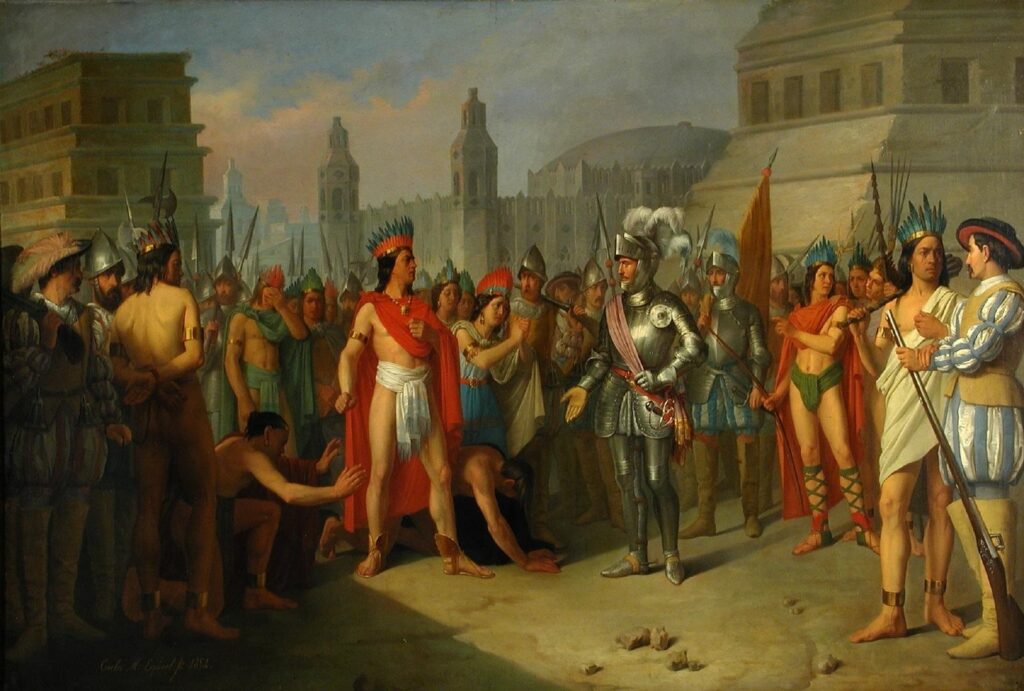
Cuauhtémoc decided to leave the city under cover of darkness to continue the resistance from the shore however he could, but his boat was spotted and he was captured. Cuauhtémoc was taken to Cortes in the Tlatelolco market, where some of the final battles were fought. Cortes’ men had raised a canopy on a platform and tables and chairs set beneath.
Cortes asked Cuauhtémoc, through the translator Marina, why he allowed for the destruction of his city after so many attempts at peace.
Diego Duran reports his response:
Tell the Captain
that I have done my duty;
I have defended my city, my kingdom,
just as he would have defended his
had I attempted to take it from him.
But I have failed.
Now that I am his captive,
let him take this dagger
and kill me with it.
Duran wrote that Cuauhtémoc begged for Cortes to take his life, placing his hands on Cortes’ dagger. His capture was the end of Tenochca-Mexica society.
With Cuauhtémoc on the platform was the lord of Tlacopan, Tetlepantquetzal and Tlacotzin, high advisor. Immediately after some honorific words from Cortes, he asked for the empire’s gold. They presented what had been salvaged from Tenochtitlan when they fled, which was a modest amount. Cortes insisted there was more and demanded they produce it. Tlacotzin snapped at Cortes that his men had melted it all down into bars, but Cortes insisted they dropped it all in the Tolteca canal on the Noche Triste. Finally Cortes seized Cuauhtémoc and took him to a nearby area where a fire was made.
In one of the more infamous scenes of the Conquest, Cortes burned Cuauhtémoc’s feet to elicit a confession about the gold. But he, nor Tetlepanquetzal, had info to offer. The Cronica says he walked with a limp from then until his death, four years later.
Following the surrender of Tenochtitlan, Cuauhtémoc lived in the palace at Tecpan, built by Cortes immediately following the surrender of the Mexica. At some point Cuauhtémoc had been baptized as Don Fernando, or Don Hernando, depending on the source. From there this noble warrior of the Mexica elite administered affairs of the market and of the city but bore no real power. There were no armies of eagle warriors or campaigns to run in far flung places. Cortes was the ruler of Mexico City and was at work dismantling Tenochtitlan.

In 1524 Cortes organized an expedition to Guatemala and, likely to keep an eye on them, brought Cuauhtémoc, Tetlepanquetzal, Tlacotzin and other lords of the Valley of Mexico along with him. On February 28, 1525 Cortes accused and convicted Cuauhtemoc of plotting against him and sentenced him to death. Cortes chose Tetlepanquetzal and Tlacaltec of Tlatelolco to die with him so as not to go to the afterlife alone. The three leaders were hung from a ceiba tree near the Maya city of Itzamkanac, now an archaeological site in Campeche, Mexico known as El Tigre.
The conquistador Bernal Diaz wrote that the killings were unjust. Cortes appointed Cuauhtémoc’s chief advisor and Eagle Warrior, Tlacotzin, as the new ruler of Tenochtitlan.
Cuauhtémoc’s Accomplishments
Led the defense of Tenochtitlan against the Second Siege by Cortes.
Tried to clean up and rebuild Tenochtitlan.
Inspired millions of people to fight with dignity.
Cuitlauhuac <<- Cuauhtemoc ->> Tlacotzin