Tenoch is the person, whether real or mythological, for whom the Aztec city of Tenochtitlan is named. But who Tenoch was, is a bit of a mystery.
He appears frequently in many of the codices, or ancient documents, preserved from before and after the Conquest. Tenoch is recognizable by his name glyph, a rock with a cactus growing on it and he appears in Mendoza, Aubin and Azcatitlan codices. Tenoch is mentioned in several post-conquest written historic documents. He shares his name glyph with the city of Tenochtitlan.
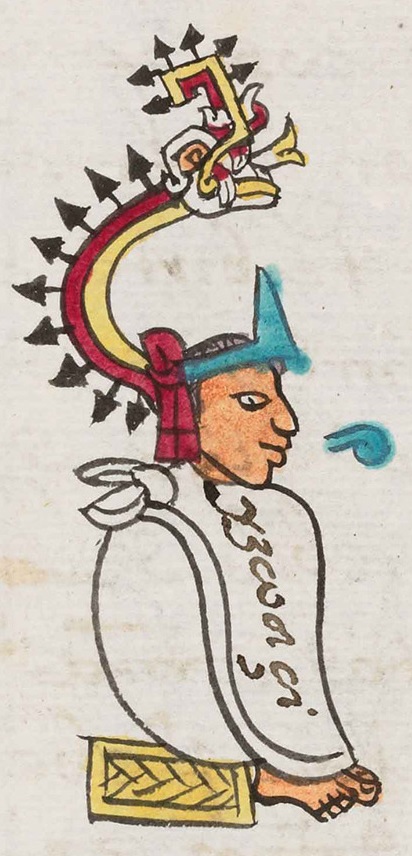
Tenoch depicted in the Codex Azcatitlan, his name-glyph below him.
Formal Name: Axayacatzin Life: 1449-1481 Reign: 1469-1481 Name: Face of water Place of Birth:
A grandson of tlatoque Moctezuma I and Itzcoatl, Axayacatl was seemingly destined to become ruler of Tenochtitlan. But his military record helped him rise above his two older brothers, Tizoc and Ahuitzotl, to become favored by the elite decision makers, like Tlacalael. He had served as Captain General and High Priest of the Templo Mayor before ascending to the throne.
After the death of his grandfather, Tlacalael met with the other leaders of the Triple Alliance, Totoquihuatzli and Nezahualcoyotl. At first the nobles and elders pleaded with Tlacalael to be the next ruler, but he declined, telling them he already ruled and was respected and his decisions heard and that he was too old to rule. He suggested Axayacatl, who he would guide and mentor, and he was chosen to succeed. Axayacatl was crowned in 1469. The new tlatoani would be a good friend of Nezahualcoyotl until his death in 1472, when Axayacatl attended his funeral. The new king’s rule was eventful.
Painting of Axayacatl, Codex Tovar 1587 or 1588.
Tensions between their sister city, Tlatelolco, and the Tenochca Mexica began to simmer. Market disputes between women from the two communities were addressed by Axayacatl, but left lasting tensions. The appointment of a Tlatelolco king, Moquihuix, was seen as a threat. Accusations by the Tlatelolca that a canal they were digging had been filled in overnight caused a great uproar, according to Duran. The Cronica Mexica says some carnal relations between Tenochca men and Tlatelolco women, perhaps rape, had also added to the fury. Eventually the list of confrontations and instigations from Moquihuix, ruler of Tlatelolco, led to conflict.
According to Duran, a Tlatelolco ambush was found out and Axayacatl attacked his Mexica neighbors starting a brief civil war that ended with the subjugation of the city and death of Moquihuix. Tlatelolco would not be considered an autonomous city again, but separate cultures remained and to this day Tlatelolco has kept a distinct aura to itself.
The History of the Chichimeca Nation, written from a Texcoco perspective, claims Axayacatl spent most of his time in Texcoco because he found it enjoyable and healthful. This seems like self-flattery by Ixtlilxochitl, a Texcoco writer, but there was a bond between the leaders of the two cities.
Axayacatl was an eager military man who expanded the empire west into the Toluca Valley. As a young man in charge of the empire under the watchful eye of Tlacaelel, he was eager to prove himself in battle. According to the Cronica, in one battle he was stabbed in the leg, causing him a lifelong limp. He led the armies of the Triple Alliance into Matlatzinca and other towns, enforcing the power of the empire.
However, this desire to expand led to the Mexica’s most disastrous defeat ever. Beyond Toluca were the Tarascan people of Michoacan, centered in the city of Tzinztuntzan. In 1476, the Mexica armies were defeated in the only major defeat ever suffered by Tenochca armies, to that point. One report claims 20,000 Mexica soldiers died. Axayacatl retreated to Ecatepec, where the army regrouped and began mourning. The bodies that were retrieved were cremated, the families given clothes and food for their sacrifice. The defeat in Michoacan came to define his rule and he died five years later in 1481 of illness. He is credited with the carving of the famous Sun Stone, by Duran, but that claim isn’t clear as it has indications it was made after his reign.
Axayacatl died in 1481 at about the age of 31. Duran says he died after a flurry of sacrifices, overwhelmed by the smell of blood and filth and exhausted from taking so many lives, which seems suspect. The Cronica says he died of a similar illness as his friend Nezahuacoyotl, growing ill over days until he died. Several sources link his defeat in Michoacan as a driving source of his demise. His forces went on to several other victories, but his reign was stained by Michoacan.
Forty years later Axayacatl’s palace would serve as living quarters, and fortress to Cortes and the Spanish-Tlaxcalan force. According to the History of the Chichimeca Nation, Axayacatl had temples to the gods built in his palace ahead of a war with Chalco. Cortes and his men described in their writing effigies of the gods in the palace when they stayed there. Perhaps the ones built 40 years earlier in preparation of war.
Axayacatl’s Accomplishments Sanctioned carving of the “Aztec Sunstone” Was a poet Expanded the empire north, west and east Loved the great ballgame, and played Was wounded in battle, left with lame leg
Formal Name: Moteuczomatzin Life: 1397/98-1469/1471 Reign: 1440-1469/1471 Name: Angry Like a Lord, fletcher of the sky Place of Birth: Tenochtitlan Died: Tenochtitlan, of illness.
Moctezuma Ilhuicamina, or Moctezuma the Elder, and his brother Tlacaelel were at the heart of the Mexica nobility and served as young generals under the violent leadership of Itzcoatl. They were part of a militant political faction that had raised Itzcoatl to the throne and stood in opposition to their other brother, and former tlatoani Chimalpopoca. After Chimalpopoca‘s assassination Itzcoatl, Moctezuma, Tlacaelel and their group took power. Moctezuma and Tlacaelel had big ambitions for the growing Mexica people.
Formal Name: Itzcoatzin Life: 1380-1440 Reign: 1425/28-1440 Name: obsidian serpent Place of Birth: Tenochtitlan Died: Tenochtitlan, of illness.
Itzcoatl was selected to lead Tenochtitlan following the death of his predecessor, Chimalpopoca, who was allegedly murdered by his uncle Maxtla, the Tepanec leader in Coyoacan. Maxtla felt his father’s loyalty to his Mexica grandson Chimlpopoca was a liability to the economic health of the Tepanecs. And so, it is accepted that Maxtla coordinated the death of the Mexica leader and his son. Additionally, the Tepanec king Tezozomoc was possibly killed later, ending the line completely. The brash assassinations seem to be entirely the work of Maxtla, however one man benefited greatly: Itzcoatl.
Born around 1380, Itzcoatl was likely the son of Tlatoani Huitzilihuitl and his favorite slave girl, her name lost to history. Perhaps this forbidden mother, more alluring to the king than the Tepanec queen, was the root of Itzcoatl’s ferocity.
Following the death of Chimalpopoca, Itzcoatl was selected to be Tlatoani, sometime between 1424 and 1428. Itzcoatl was a new generation of leader in the Mexica world, he wasn’t content to report to another nation. Nor was his brother, the young and powerful Mexica noble, Tlacaelel. His coronation made Maxtla and other Tepanec leaders nervous. Maxtla sent a force that actually overran the Mexica defenses and occupied the city for some time. It was Nezahualcoyotl of Texcoco who came to their salvation and drove out the Tepanecs. Nezahualcoyotl, the legendary poet warrior of Texcoco, had a fondness for the Mexica from his time as a willing prisoner under Chimalpopoca’s rule. In a show of loyalty the Texcoco king returned all of Tenochtitlan to Itzcoatl.
Illustration of Itzcoatl, Codex Tovar 1587 or 1588.
A group of leading men from Tenochtitlan thought it best to go to Azcapotzalco and pledge allegiance to Tezozomoc on behalf of Itzcoatl, to minimize any ideas of conflict. Tlacalael, then a young warrior, stood up to these men and urged them not to offer their subjugation so quickly. He managed to convince Itzcoatl to send him to Azcapotzalco to see the king Tezozomoc, to understand why the Tepanec army was surrounding them. Tezozomoc admitted he had lost the faith of his son Maxtla and other leaders and that they now acted on their own. Having presented this information to Itzcoatl, Tlacalael was again sent to Tezozomoc, this time with an ultimatum – war or subjugation.
The threat seems to have worked as Maxtla, Cuecuex and Tezozmoc backed down, pulling their troops. But tempers remained high between Maxtla and the Mexica leaders Itzcoatl and Tlacalael. This moment, the new leadership overruling the elders who were ready to beg forgiveness and subjugation, is the beginning of Tlacalael’s influence that would continue through his mentorship of four tlatoque, past his death until the end of the Empire.
Many of the Mexica nobles were still under the glow of what used to be the protective cloak of Tezozomoc and his love for his grandson, Chimalpopoca. But things had changed and Itzcoatl was intent on making the Mexica a dominant group in the Valley. His nemesis, Maxtla, had similar aspirations having expanded his territory from Coyoacan to Azcapotzalco by overthrowing his half-brother Tayatzin after his father Tezozomoc’s death.
A clear rivalry had been built upon Maxtla’s anger at the favoritism the Mexica had received from his father Tezozomoc. That rift was exploited by Itzcoatl and Tlacalael to force the Mexica out from under Tepanec control. In the midst of this tension a group of Tepanecs assaulted and stole the goods from a group of Mexica women who had traveled to Coyoacan to sell their produce. Itzcoatl ordered that all relations with the Tepanecs in Coyoacan cease, including trade. Pretty quickly this impacted Tepanec supplies and people began to starve in Coyoacan. Maxtla was faced with a choice, a choice that Itzcoatl forced. With control of the lakes, the Mexica thrived. The Cronica tells how those starving in Coyoacan were tormented by the smells of savory cooked meats wafting across the lake.
According to several narratives, Itzcoatl’s brother and loyal advisor Tlacalael, was sent to Coyoacan to deliver a message to Maxtla. Tlacalael went and talked his way into the city and to the royal palace where he was presented to Maxtla. Tlacalael, familiar with all the courtly etiquette, came for an answer, would it be peace or would there be war? Maxtla vowed no Tepanec would ever be ruled by the Mexica. According to the Cronica Mexicayotl, Maxtla dressed the Mexica emissaries in women’s clothing and sent them back to Tenochtitlan. Itzcoatl took this as the answer that Maxtla had chosen war.
Itzcoatl sent guards to the border of Tepanec lands where a small group of Maxtla’s men were, according to the Cronica. The men ran but offered plenty of insults on their way out. From here the Mexica guards spotted smoke in the lagoon and traced it to three Tepanec fishermen. The men were given weapons and a running lead then were pursued to Coyoacan where the Mexica, along with Nezahualcoyotl’s forces, destroyed the temple and looted the city. According to the Cronica, the Tepanecs of Coyoacan were sent fleeing into the hills. It is said Nezahualcoyotl personally sacrificed Maxtla.
Tlacaelel reported the outcome of the Tepanec-Mexica war to Itzcoatl, a sound victory over Maxtla’s forces. The Tepanec leaders’ requests to other towns for reinforcements had all been denied and alone they fell to the aggressive Mexica allies and their generals Tlacalael, Nezahualcoyotl and another young warrior named Moctezuma Ilhuicamina.
With the destruction of Maxtla, Tepanec power landed on Totoquihuatzli the 1st, who either was an ally or realized it was best to become one. This set the stage for establishment of the Triple Alliance, or what is casually referred to as the Aztec Empire. The king of Texcoco and ruler of the Acolhua people, Nezahualcoyotl became the third power. The three rulers, Itzcoatl, Nezahuacoyotl and Totoquihuatzli, formed the Triple Alliance that would rule the Valley of Mexico until 1521.
After cementing the Tepanec alliance and control of the central Valley and lakes, Itzcoatl moved south into the lake cities of Xochimilco and Chalco. But first he took down the altepetl of Culhuacan, the traditional superpower and the city from which the Mexica borrowed the noble blood to establish their own monarchy. Then they moved on to the southern chinampa towns of Xochimilco, Cuitlauhuac, Mixquic and others. Lands from all these victories were distributed to the royal court, the generals and all the valiant warriors who had distinguished themselves in war.
With the entire Valley in their control, the lords of the Triple Alliance began to establish their titles and districts. Initially Itzcoatl felt Nezahualcoyotl and his title of Lord of the Empire was too powerful and they negotiated a more humble title of Lord of the Aculhua people with their capital in Texcoco. Itzcoatl took the title of Lord of the Culhua, Totoquihuatzli of Tlacopan took on the Tepanec lands and people. With their power consolidated the Triple Alliance sent the armies toward the people of Cuahnahuac, now called Cuernavaca.
Itzcoatl died after a short illness in 1440. Before his death he assigned ranks to the other two Triple Alliance powers, Tenochtitlan would be the dominant power with Texcoco second and the Tepanecs in Tlacopan third. After his death he was succeeded by his nephew Moctezuma Ilhuicamina, who had served as a general in Itzcoatl’s campaigns in Coyoacan, and the southern lake towns.
Itzcoatl’s legacy would be sealed through his marriage to Huacaltzintli, a princess of Tlatelolco. Her brother, Tlacateotl, was king of Tlatelolco, and she would be grandmother to three kings of Tenochtitlan. Itzcoatl and his faction, including his generals Tlacalael and Moctezuma Ilhuicamina, had made the Mexica a powerful force in mesoamerica, and his successors would continue in this aggressive style of violent expansion.
Formal Name: Chimalpopocatzin Life: 13??/1407 (Duran)-1424/28 Reign: 1417-1424/28 Name: obsidian serpent Place of Birth: Tenochtitlan Died: Tenochtitlan, likely assassinated.
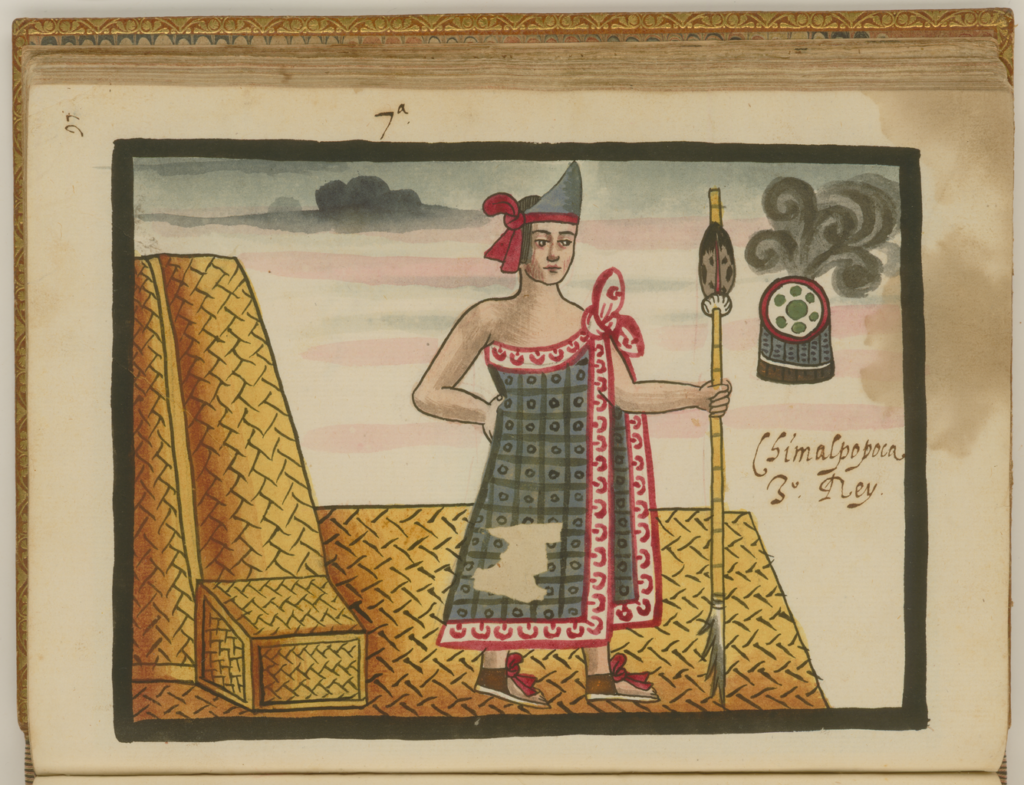
While it’s commonly accepted Chimalpopoca is the son of Huitzilihuitl, and grandson of Acamapichtli, there are versions of history that say his father was Acamapichtli, the first ruler of Tenochtitlan. It does seem he was the favorite grandson of the ruler of Atzcapozalco, Tezozomoc, according to several sources. I’m going to go with the version where he is the grandson of Acamapichtli and Tezozomoc. Chimalpopoca’s name means smoking shield and his name glyph is shown as a shield, or chimalli in Nahuatl, with smoke rising off the top.
Illustration of Chimalpopoca, Codex Tovar 1587 or 1588.
According to Duran he was only 10 years old at the time of his selection around 1417, Duran’s dates are often inaccurate. He was likely born in Tenochtitlan, as it’s mentioned that messengers were sent to Azcapotzalco after his birth to inform his grandfather Tezozomoc.
Militarily, Chimalpopoca kept the Mexica alliance with the Tepanecs, and they remained a vassal to the Tepanec capital of Azcapotzalco. After a war in 1418, the Mexica support of the Tepanecs was rewarded with the city of Texcoco. However, Chimalpopoca kindly allowed the ruler of Texcoco, the legendary Nezahualcoyotl, to live in Tenochtitlan rather than be exiled to the mountains. Chimalpopoca would leave a lasting imprint on his nephew Nezahuacoyotl, whose later loyalty to the Mexica would be invaluable.
The Chapultepec Springs and the fresh water that spilled out became an object of Mexica desire, and the nobles went to Chimalpopoca to urge him to use his favoritism with his grandfather Tezozomoc. The Mexica king went to his grandfather and asked permission to access the water. Permission was given but soon tensions rose between the two cities as the people disagreed about granting the Mexica water rights. Tepanec nobles became increasingly disgruntled with Tezozomoc and his weakness for his grandson. There seems to have even been confusion as to what access meant, some Tepanecs believing buckets, while the Mexica meant an aqueduct. To push things further, the Mexica requested the clay and lyme to build the aqueduct. Nevertheless, Tezozomoc allowed the aqueduct to be built while averting violence, for the moment.
Chimalpopoca dressed as the god Huitzilopochtli
The man most affected by this soft loyalty from Tezozomoc toward Chimalpopoca, was Tezozomoc’s own son Maxtla.
Chimalpopoca’s death is shrouded in intrigue as several narratives exist on the cause of his demise. One version says after fending off an attack by Coyoacan’s ruler, Maxtla, Chimalpopoca was taken hostage by the Tepanecs and taken to Azcapotzalco, where he died. Either by suicide, murdered by the Tepanecs or assassinated by his uncle Itzcoatl, the next tlatoani or self-sacrificed. Duran claims he was murdered in his palace by order of the Tepanecs, along with his young son Teuctleuac. Both the History of the Chichimeca Nation and the Cronica Mexicayotl agree that Chimalpopoca was assassinated by the Tepanecs to end the alliance and the drain on Tepanec resources.
The next ruler of the Mexica would bring the sword to the Tepanecs, lacking the loyalty his nephew Chimalpopoca had to their now dead king Tezozomoc. Itzcoatl also had a much more grand vision for the Mexica.
His rule, from about 1417 to 1427, oversaw the building of a wood and clay aqueduct from Chapultepec into the city, as well as construction of a causeway to Tlacopan – both significant infrastructure improvements for early Tenochtitlan. He is remembered for the favors he garnered from his powerful grandfather, Tezozomoc.